
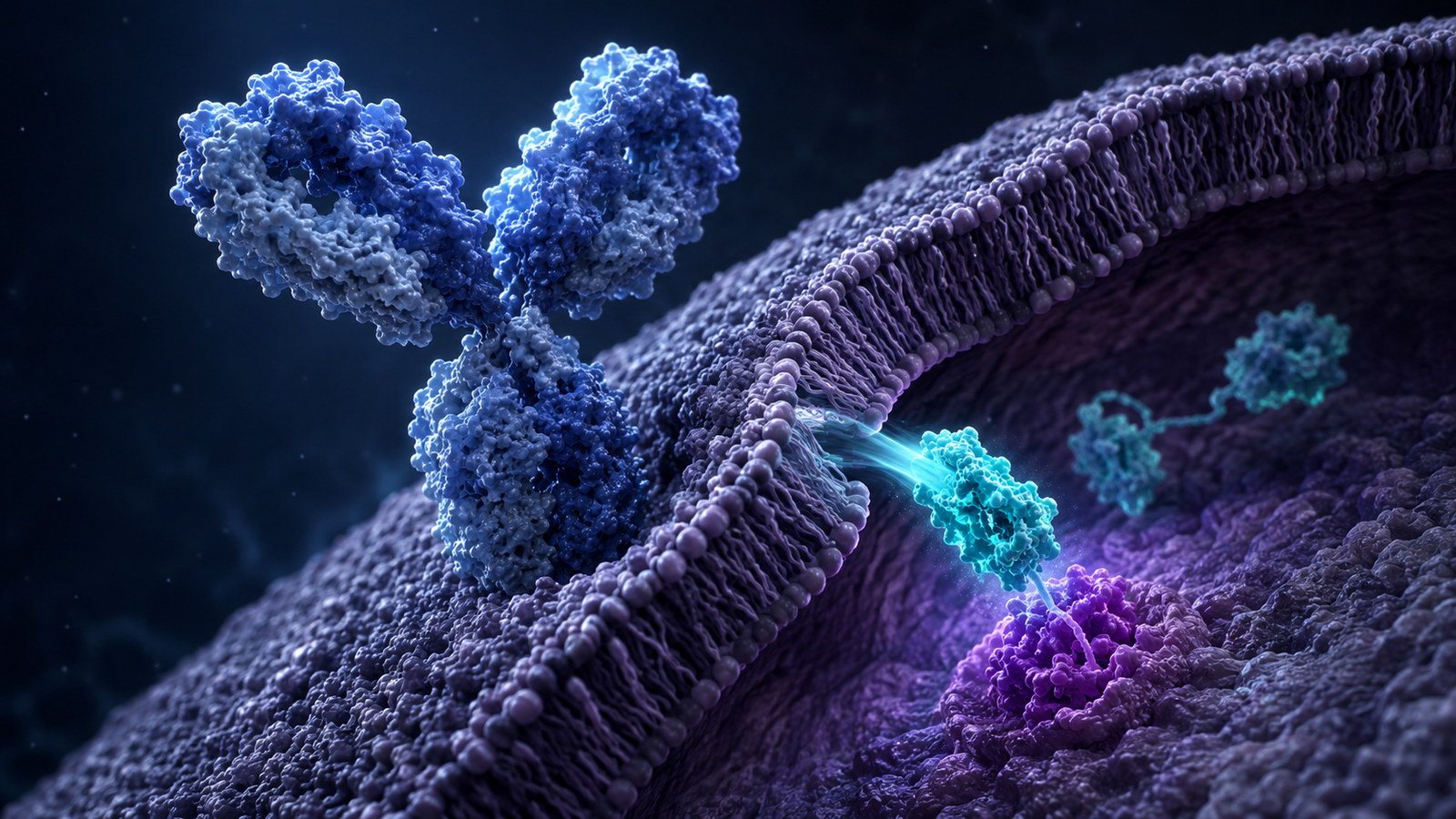
Quick answer: Nanobodies and conventional monoclonal antibodies both bind targets with high specificity, but they differ dramatically in size and structure. A conventional monoclonal antibody is a large protein (~150 kDa) with heavy and light chains; a nanobody is a single small domain (~15 kDa) derived from camelid heavy-chain-only antibodies. That size difference gives nanobodies potential advantages in tissue penetration, target access, stability, and engineering flexibility, which is why they are an increasingly studied modality in drug development.
Structural differences
A conventional monoclonal antibody is built from four protein chains (two heavy, two light) folded into the familiar Y shape, with two binding arms. A nanobody consists of just the single variable domain (VHH) that does the binding. Removing everything else leaves a compact, robust protein about one-tenth the size.
How that affects targeting
Because they are small and have a differentiated paratope format, nanobodies can potentially reach into narrow clefts and hidden epitopes on a target protein that a bulky antibody cannot access. This can matter for targets that have been considered undruggable by larger molecules, particularly those located inside the cell. Nanobodies can also be fused together to build multi-target or multivalent constructs. Unlike traditional antibody-drug conjugates (ADCs), PHP Biotech’s Platform integrates the therapeutic sequence directly into the nanobody during recombinant expression, producing a single functional biologic without chemical conjugation or linker technologies — an approach the company describes as linker-free biologics, or recombinant nanobody therapeutics.
Comparing key properties
Size: nanobody ~15 kDa vs. monoclonal antibody ~150 kDa.
Source: nanobodies derive from camelid heavy-chain-only antibodies; monoclonals are typically produced in mammalian cell systems.
Tissue & target access: smaller size may aid distribution into dense tissue and access to intracellular targets.
Stability & engineering: nanobodies are generally stable and modular, supporting flexible nanobody engineering and recombinant production.
Maturity: monoclonal antibodies are a well-established therapeutic class; nanobody therapeutics are a newer, fast-growing field.
Why this matters for next-generation therapeutics
Conventional monoclonal antibodies transformed medicine, but their size limits which targets they can reach — particularly targets inside the cell. Nanobodies expand the toolkit, offering researchers a way to pursue mechanisms that were previously hard to address. PHP Biotech is applying this shift through a programmable nanobody Platform: a linker-free, recombinant biologic drug delivery platform engineered to create first-in-class biologics that is able to act on intracellular targets. PHP53-nb is the platform’s first proof-of-concept, with the same architecture intended to support future bispecific, multispecific, and other next-generation biologics. See Our Science for more on how PHP53-nb is being studied, and the Potential Impact page for why this approach matters. The company’s research remains at the preclinical stage.
Frequently asked questions
Are nanobodies better than antibodies?
Not universally — they are different tools. Nanobodies offer advantages in size and access; monoclonal antibodies are a mature, proven class.
How much smaller is a nanobody?
Roughly one-tenth the size of a full monoclonal antibody.
Can nanobodies be humanized?
Yes. Nanobodies can be engineered (humanized) to reduce the risk of an immune response, as with PHP Biotech’s humanized nanobody platform.
Are nanobody drugs on the market?
Yes. Two nanobody-based therapies have reached the market, and an extensive clinical pipeline is advancing candidates for cancer, autoimmune and inflammatory diseases, infectious diseases, hematological disorders, and central nervous system disorders — reflecting the rapid expansion of this modality.
About PHP Biotech
PHP Biotech is a U.S.-based platform biotechnology company developing a proprietary nanobody Platform for precision oncology. Its linker-free, humanized nanobody platform integrates the therapeutic sequence directly into the nanobody through recombinant expression — an approach to recombinant nanobody therapeutics engineered to reach historically undruggable intracellular targets and to create a new class of biologics. The same programmable platform is designed to generate future multispecific and other next-generation biologics, produced in CHO cells to support industrial-scale recombinant manufacturing. PHP53-nb — a humanized nanobody in preclinical development, studied for p53 reactivation — is the first proof-of-concept generated by the platform, not the company’s only program. PHP Biotech’s intellectual property portfolio currently includes four U.S. patent applications covering the platform, the recombinant production technology, the therapeutic peptide library, and PHP53-nb.
Learn more at phpbiotech.com. This content is educational, describes research in model systems, and makes no efficacy, safety, or treatment claims about PHP53-nb.