
Category: Uncategorized

  • upar-receptor-php53-nb-internalization

    upar-receptor-php53-nb-internalization

    uPAR Identified as the Entry Receptor for PHP53-nb | PHP Biotech
    Research Update

    uPAR Identified as the Entry Receptor for PHP53-nb

    What a confirmed cell surface receptor means for p53 restoring cancer therapy, a clinical grade imaging path, and a modular future for the platform.

    PHP Biotech has identified the urokinase plasminogen activator receptor (uPAR) as the cell surface protein that binds and internalizes PHP53-nb, the company’s investigational p53 restoring nanobody. The finding explains how PHP53-nb enters tumor cells, supports its documented tumor selectivity, and connects the program to a receptor that is already imaged in patients and is now the target of CAR T programs at leading research institutions.

    This article explains what uPAR is, why the identification matters, how the internalization cascade works, and what it could mean for the future of the PHP53-nb platform.

    What is uPAR?

    uPAR is a protein found on the surface of cells that helps tumors break down surrounding tissue, invade, and spread. For roughly three decades it has been one of the most consistent markers of aggressive cancer: the more uPAR a tumor expresses, the more likely it is to invade, metastasize, and recur.

    uPAR is found in a broad set of 30+ cancer types, including breast, pancreatic, colorectal, and brain tumors, and not only on the cancer cells themselves, but on the supporting stroma that surrounds them.

    What did PHP Biotech discover?

    PHP Biotech identified uPAR as the entry point for PHP53-nb into the tumor cell, the surface receptor that mediates the nanobody’s binding and its internalization into the cytoplasm. Until now, PHP53-nb was known to bind a tumor associated membrane ligand and enter by endocytosis; the receptor itself was not named. Identifying uPAR closes that gap and links PHP53-nb to a large body of existing research on the receptor.

    Why this matters beyond a single molecule

    The uPAR finding matters because the receptor has shifted from a target researchers tried to block into a delivery address the field actively uses.

    450+ patients imaged

    More than 450 patients have already been imaged with uPAR directed PET agents across nine Phase 2 clinical trials, making uPAR one of the rare oncology targets visualized in humans before being treated at scale.

    Cell · 2026

    Researchers at Memorial Sloan Kettering and Columbia published a uPAR directed CAR T cell program, tested in lung, pancreatic, and ovarian cancer models.

    Science Translational Medicine · 2026

    Independently, a team at McMaster University and King’s College London published a uPAR directed CAR T approach for recurrent glioblastoma.

    How PHP53-nb enters a cancer cell

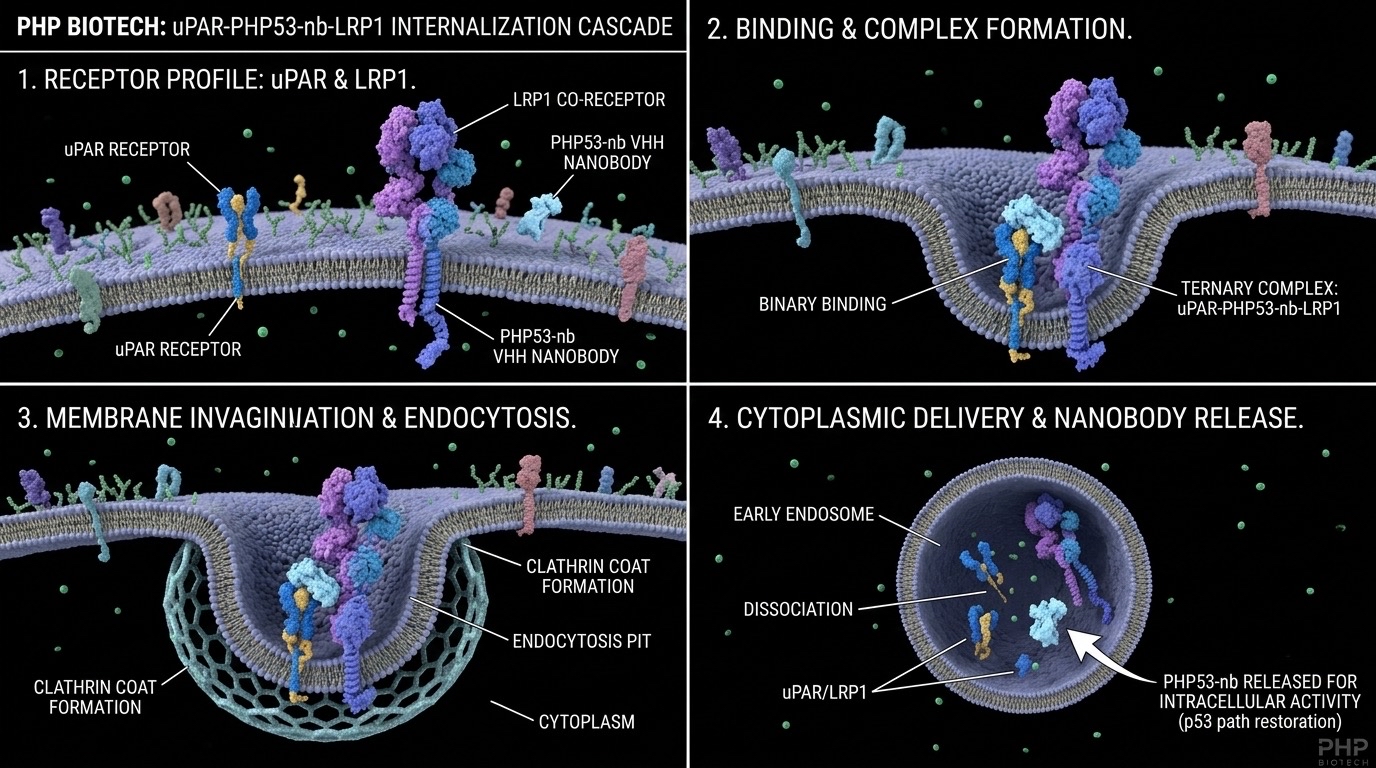
    Four steps, shown in PHP Biotech’s uPAR–PHP53-nb–LRP family internalization cascade.

    Step 1

    Receptor recognition

    PHP53-nb, a humanized VHH nanobody, encounters uPAR on the tumor cell surface, where the LRP family receptors are also present.

    Step 2

    Binding and complex formation

    PHP53-nb binds uPAR (binary binding), then a ternary complex forms: uPAR–PHP53-nb–LRP.

    Step 3

    Membrane invagination and endocytosis

    A clathrin coat assembles and the membrane folds inward, pulling the complex into the cell in an endocytic pit.

    Step 4

    Cytoplasmic delivery and release

    Inside the early endosome, the complex dissociates. uPAR and LRP separate from the nanobody, and PHP53-nb is released into the cytoplasm for intracellular activity, the restoration of the p53 pathway.

    What this means for tumor selectivity

    uPAR mediated entry offers a molecular explanation for the tumor selectivity PHP53-nb has shown in prior research. Because uPAR is enriched on aggressive tumor cells and their stroma and comparatively sparse on healthy tissue, a therapeutic that depends on uPAR for entry is expected to concentrate its activity where the receptor is abundant. This is consistent with the low toxicity to normal cells observed in PHP53-nb’s preclinical models.

    Could imaging select patients for treatment?

    Potentially, yes. Because clinical grade uPAR-PET imaging agents already exist and are currently used in clinical trials, there is a prospect of identifying patients whose tumors express uPAR before treatment. This companion imaging approach, image the target first, then treat, is something most early stage programs cannot borrow from day one. PHP Biotech has not yet initiated clinical studies, and any patient selection strategy would be defined during clinical development.

    PHP53-nb’s dual profile

    Two distinct mechanisms, operating at two locations in the cell.

    uPAR: Cell surface

    Handles recognition and internalization. The receptor is enriched on aggressive tumor cells and their stroma, giving the nanobody a selective route in.

    p53: Inside the cell

    Drives the therapeutic effect by restoring a pathway that is lost or disabled in roughly half of all human cancers.

    Most targeted therapies rely on a single antigen for both recognition and effect; PHP53-nb separates the two, which the company describes as a sharper logic than the single antigen approach prevailing in the field. This could support better patient selection for future clinical trials.

    Why the nanobody format matters

    It matters because nanobodies are highly modular. PHP53-nb is a humanized camelid nanobody, small, stable, easily conjugated, and readily engineered into multispecific formats. A binder with a confirmed uPAR mediated internalization route is therefore not just a therapeutic; it is, in principle, a delivery vehicle as well.

    The same molecule that carries a p53 pathway restoring mechanism today could be developed into a radioligand, an antibody drug conjugate (ADC), or a bispecific T-cell engager in the future, combining biological tumor suppressor restoration with a cytotoxic payload or with another nanobody that activates T-cells against the most aggressive tumors.

    What’s next

    PHP53-nb remains in preclinical development and is investigational; it has not been approved by the FDA or any regulatory authority. The uPAR identification informs the company’s translational strategy, including how tumor selectivity is characterized, how patient populations might be defined, and how the nanobody platform could be extended into additional formats. PHP Biotech will share further updates as the program advances.

    Frequently asked questions

    What is PHP53-nb?

    PHP53-nb is PHP Biotech’s investigational lead candidate: a first-in-class humanized camelid nanobody that incorporates the p53 pathway restoring peptide 3-NAntC. It is designed to enter tumor cells, restore the p53 axis, and trigger programmed cell death (apoptosis), beginning with triple negative breast cancer.

    What does uPAR stand for?

    uPAR stands for urokinase plasminogen activator receptor. It is a cell surface protein strongly associated with tumor invasion, metastasis, and recurrence across several aggressive cancer types.

    Which cancers express uPAR?

    uPAR is found across 30+ cancer types, including breast, pancreatic, colorectal, and brain tumors, among others. It is present on malignant cells and on the supporting stroma around them.

    What is LRP1’s role in PHP53-nb internalization?

    LRP1 acts as a co-receptor. After PHP53-nb binds uPAR, a ternary uPAR–PHP53-nb–LRP1 complex forms and is internalized through clathrin mediated endocytosis.

    Has uPAR been imaged in patients?

    Yes. More than 450 patients have been imaged with uPAR directed PET agents across nine Phase 2 trials, making it one of the few oncology targets visualized in humans before being treated therapeutically at scale.

    Is PHP53-nb approved or available to patients?

    No. PHP53-nb is investigational, in preclinical development, and has not been approved by the U.S. FDA or any other regulatory authority. This article is not medical advice.

    Could PHP53-nb become an ADC or radioligand?

    In principle, yes. Because nanobodies are modular and PHP53-nb has a confirmed uPAR mediated internalization route, the company views radioligand and ADC formats as future possibilities for the platform.

    PHP53-nb remains investigational and has not been evaluated or approved by the FDA. This content is intended for the scientific, clinical, and investment communities and does not constitute medical advice.

    Learn more at phpbiotech.com
  • Nanobodies vs. Monoclonal Antibodies: Key Differences in Size, Targeting & Therapeutic Potential

    Nanobodies vs. Monoclonal Antibodies: Key Differences in Size, Targeting & Therapeutic Potential

    Quick answer: Nanobodies and conventional monoclonal antibodies both bind targets with high specificity, but they differ dramatically in size and structure. A conventional monoclonal antibody is a large protein (~150 kDa) with heavy and light chains; a nanobody is a single small domain (~15 kDa) derived from camelid heavy-chain-only antibodies. That size difference gives nanobodies potential advantages in tissue penetration, target access, stability, and engineering flexibility, which is why they are an increasingly studied modality in drug development.

    Structural differences

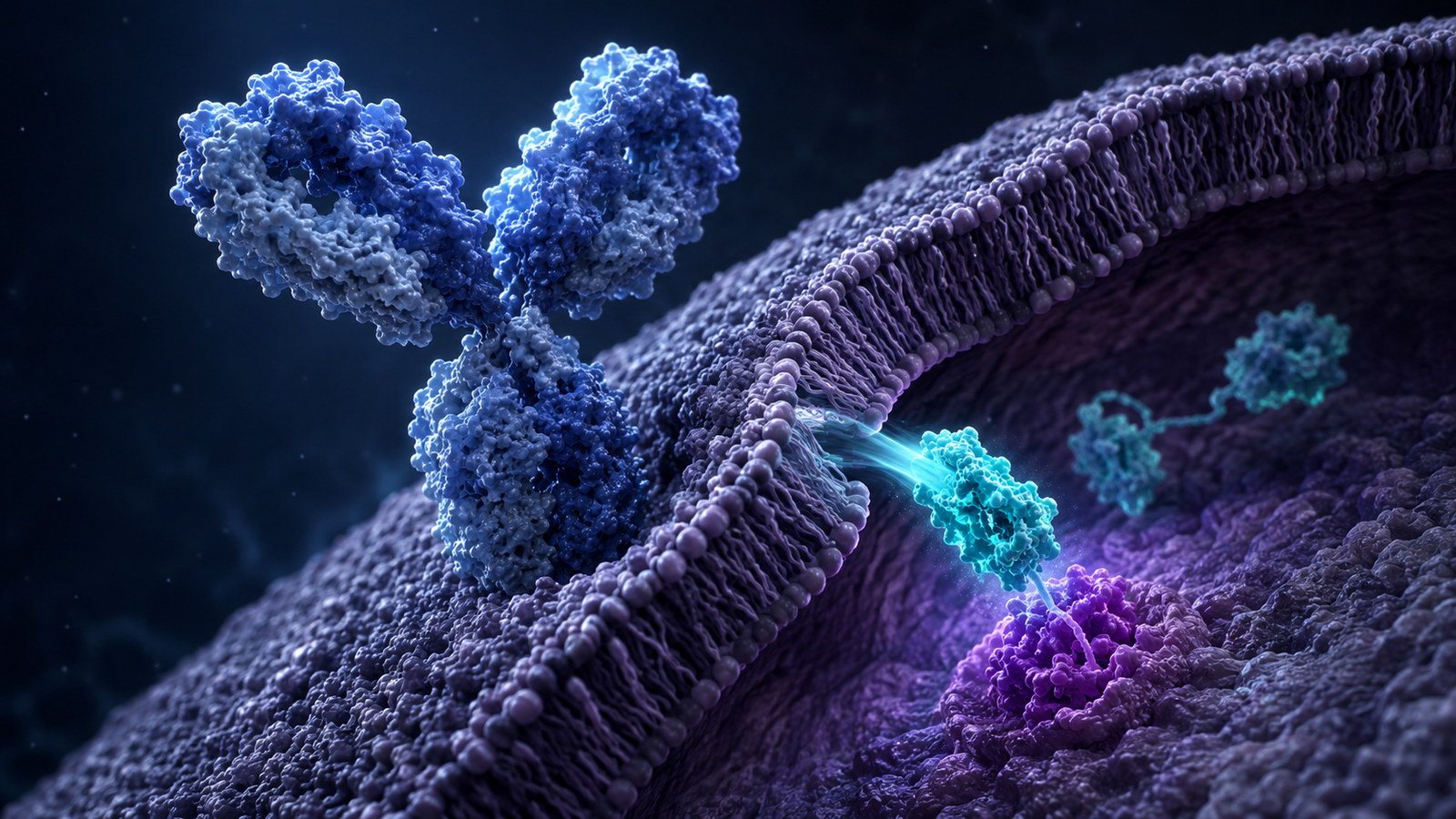
    A conventional monoclonal antibody is built from four protein chains (two heavy, two light) folded into the familiar Y shape, with two binding arms. A nanobody consists of just the single variable domain (VHH) that does the binding. Removing everything else leaves a compact, robust protein about one-tenth the size.

    How that affects targeting

    Because they are small and have a differentiated paratope format, nanobodies can potentially reach into narrow clefts and hidden epitopes on a target protein that a bulky antibody cannot access. This can matter for targets that have been considered undruggable by larger molecules, particularly those located inside the cell. Nanobodies can also be fused together to build multi-target or multivalent constructs. Unlike traditional antibody-drug conjugates (ADCs), PHP Biotech’s Platform integrates the therapeutic sequence directly into the nanobody during recombinant expression, producing a single functional biologic without chemical conjugation or linker technologies — an approach the company describes as linker-free biologics, or recombinant nanobody therapeutics.

    Comparing key properties

    Size: nanobody ~15 kDa vs. monoclonal antibody ~150 kDa.
    Source: nanobodies derive from camelid heavy-chain-only antibodies; monoclonals are typically produced in mammalian cell systems.
    Tissue & target access: smaller size may aid distribution into dense tissue and access to intracellular targets.
    Stability & engineering: nanobodies are generally stable and modular, supporting flexible nanobody engineering and recombinant production.
    Maturity: monoclonal antibodies are a well-established therapeutic class; nanobody therapeutics are a newer, fast-growing field.

    Why this matters for next-generation therapeutics

    Conventional monoclonal antibodies transformed medicine, but their size limits which targets they can reach — particularly targets inside the cell. Nanobodies expand the toolkit, offering researchers a way to pursue mechanisms that were previously hard to address. PHP Biotech is applying this shift through a programmable nanobody Platform: a linker-free, recombinant biologic drug delivery platform engineered to create first-in-class biologics that is able to act on intracellular targets. PHP53-nb is the platform’s first proof-of-concept, with the same architecture intended to support future bispecific, multispecific, and other next-generation biologics. See Our Science for more on how PHP53-nb is being studied, and the Potential Impact page for why this approach matters. The company’s research remains at the preclinical stage.

    Frequently asked questions

    Are nanobodies better than antibodies?
    Not universally — they are different tools. Nanobodies offer advantages in size and access; monoclonal antibodies are a mature, proven class.

    How much smaller is a nanobody?
    Roughly one-tenth the size of a full monoclonal antibody.

    Can nanobodies be humanized?
    Yes. Nanobodies can be engineered (humanized) to reduce the risk of an immune response, as with PHP Biotech’s humanized nanobody platform.

    Are nanobody drugs on the market?
    Yes. Two nanobody-based therapies have reached the market, and an extensive clinical pipeline is advancing candidates for cancer, autoimmune and inflammatory diseases, infectious diseases, hematological disorders, and central nervous system disorders — reflecting the rapid expansion of this modality.

    About PHP Biotech

    PHP Biotech is a U.S.-based platform biotechnology company developing a proprietary nanobody Platform for precision oncology. Its linker-free, humanized nanobody platform integrates the therapeutic sequence directly into the nanobody through recombinant expression — an approach to recombinant nanobody therapeutics engineered to reach historically undruggable intracellular targets and to create a new class of biologics. The same programmable platform is designed to generate future multispecific and other next-generation biologics, produced in CHO cells to support industrial-scale recombinant manufacturing. PHP53-nb — a humanized nanobody in preclinical development, studied for p53 reactivation — is the first proof-of-concept generated by the platform, not the company’s only program. PHP Biotech’s intellectual property portfolio currently includes four U.S. patent applications covering the platform, the recombinant production technology, the therapeutic peptide library, and PHP53-nb.

    Learn more at phpbiotech.com. This content is educational, describes research in model systems, and makes no efficacy, safety, or treatment claims about PHP53-nb.

  • Understanding Triple-Negative Breast Cancer (TNBC): Why It’s Hard to Treat and Where Research Is Headed

    Understanding Triple-Negative Breast Cancer (TNBC): Why It’s Hard to Treat and Where Research Is Headed

    Quick answer: Triple-negative breast cancer (TNBC) is a form of breast cancer whose cells lack the three receptors most commonly targeted by breast-cancer therapies: estrogen receptor (ER), progesterone receptor (PR), and HER2. Because those targets are absent, several standard treatments do not work against it, which makes TNBC more aggressive and harder to treat. It is a major focus of new drug research aimed at finding fresh molecular targets.

    What “triple-negative” means

    Many breast cancers grow in response to hormones (through the ER and PR receptors) or overexpress the HER2 protein, and effective therapies exist that target each of these. TNBC cells test negative for all three. That is good news in the sense that it defines the disease precisely, but it removes the receptor-targeted and hormone-based treatment options that help many other breast-cancer patients.

    Why TNBC is so challenging

    TNBC tends to be more aggressive, is more likely to affect younger patients, and historically has had fewer targeted-treatment options and lower survival rates than receptor-positive breast cancers. Because it lacks the common targets, treatment has often relied more heavily on chemotherapy. This gap is precisely why researchers are working to identify new vulnerabilities in TNBC cells.

    Where research is headed

    Scientists are pursuing multiple avenues in TNBC, including immunotherapy approaches, antibody-drug conjugates, and strategies aimed at genetic drivers of the disease. One area of interest involves the p53 pathway, since TP53 mutations are common in TNBC. New modalities — including small, precise molecules such as nanobodies that may reach intracellular targets — are being explored as ways to address vulnerabilities that have been difficult to drug. Visit Our Science to see how these approaches are being studied in preclinical models.

    PHP Biotech’s focus on aggressive cancers

    PHP Biotech is a platform biotechnology company focused on the most aggressive cancers, with TNBC as a lead area of interest for its research candidate PHP53-nb. Its proprietary nanobody platform is built as a precision oncology platform — centered on tumor-selective delivery aimed at biologically defined tumor subpopulations — and is designed to produce tumor-selective biologics that reach intracellular targets long considered undruggable. PHP53-nb, the platform’s first proof-of-concept, is being studied in preclinical models; the platform itself is intended to generate additional precision therapeutics over time. See the Potential Impact page for more on why this matters for hard-to-treat cancers like TNBC. According to the World Health Organization, breast cancer accounts for hundreds of thousands of deaths worldwide each year, underscoring why continued research into hard-to-treat subtypes like TNBC matters. All PHP Biotech findings to date are from preclinical model systems.

    Frequently asked questions

    What makes breast cancer “triple-negative”?

    The cancer cells lack estrogen, progesterone, and HER2 receptors — the three most common treatment targets.

    Why is TNBC harder to treat?

    Without those receptors, hormone and HER2-targeted therapies do not work, leaving fewer targeted options.

    Who does TNBC affect?

    It can affect anyone with breast tissue but is more common in younger patients and certain populations.

    Is there new hope for TNBC?

    Research is active across immunotherapy, antibody-drug conjugates, and novel targeted approaches — including intracellular nanobody strategies — though outcomes depend on each program’s studies.

    This article is educational and is not medical advice. Patients should consult their oncology team about diagnosis and treatment.

    About PHP Biotech

    PHP Biotech is a U.S.-based platform biotechnology company developing a proprietary nanobody platform for precision oncology. Its linker-free, humanized nanobody platform integrates the therapeutic sequence directly into the nanobody through recombinant expression — an approach to recombinant nanobody therapeutics engineered to reach historically undruggable intracellular targets and to create a new class of biologics. The same programmable platform is designed to generate future multispecific and other next-generation biologics, produced in CHO cells to support industrial-scale recombinant manufacturing. PHP53-nb — a humanized nanobody in preclinical development, studied for p53 reactivation — is the first proof-of-concept generated by the platform, not the company’s only program. Meet the team behind this research on the About Us page. PHP Biotech’s intellectual property portfolio currently includes four U.S. patent applications covering the platform, the recombinant production technology, the therapeutic peptide library, and PHP53-nb.

    Learn more at phpbiotech.com. This content is educational, describes research in model systems, and makes no efficacy, safety, or treatment claims about PHP53-nb.

  • 3-NAntC: A Potent Crotoxin B-Derived Peptide against the Triple-Negative MDA-MB-231 Breast Cancer Cell Line.

    3-NAntC displayed superior anti-tumor activity in vitro compared to cisplatin and comparable activity to doxorubicin with more favorable tolerability.