
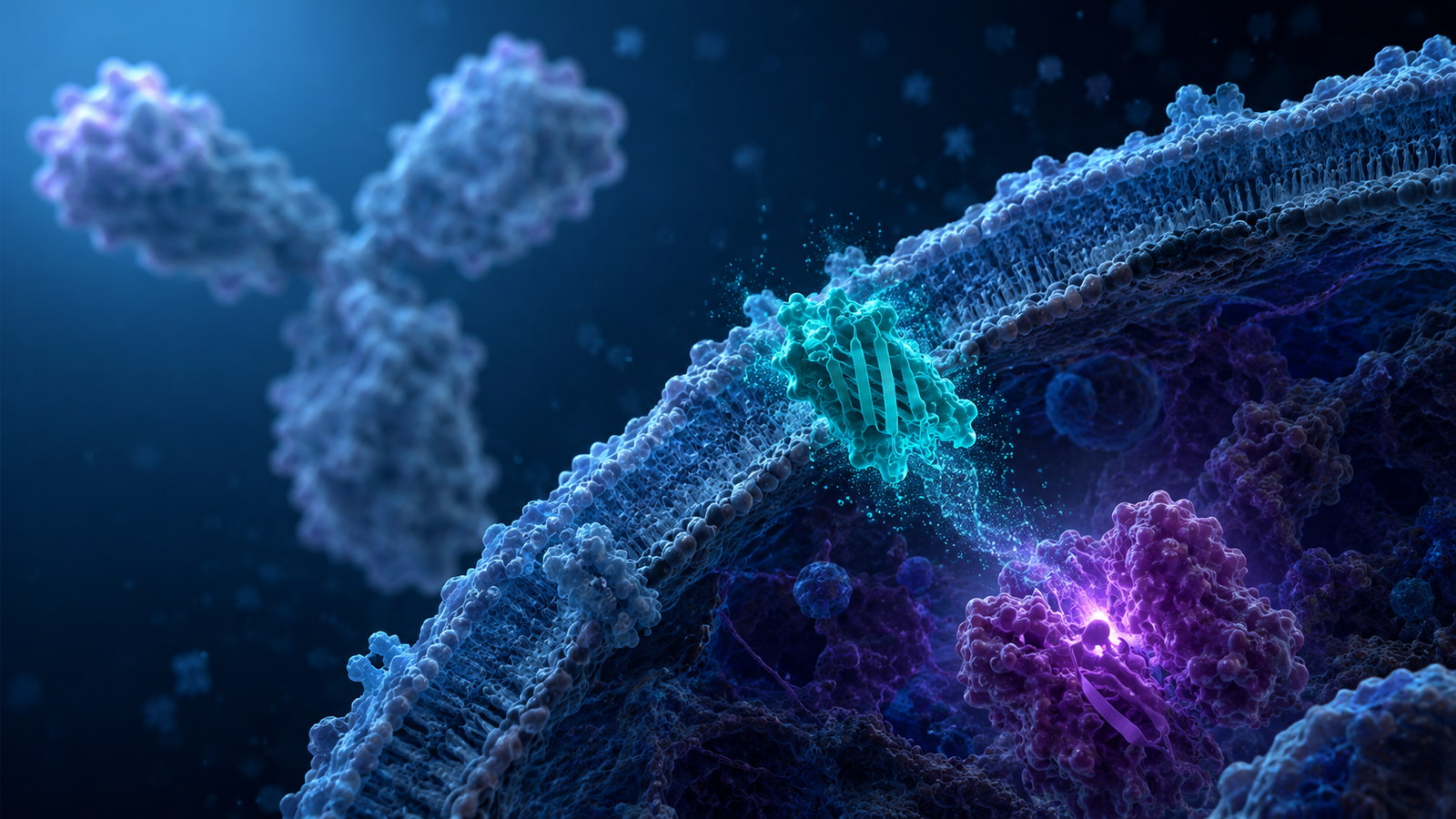
Where nanobodies come from
Most antibodies in humans are large, Y-shaped proteins built from both heavy and light protein chains. Camelids, however, also make “heavy-chain-only” antibodies. The single binding region of one of these antibodies, known as a VHH domain, can be isolated and used on its own. That isolated fragment is what scientists call a nanobody, or single-domain antibody.
Why size matters in drug development
A nanobody is about 15 kilodaltons, compared with roughly 150 kilodaltons for a conventional monoclonal antibody. This small size gives researchers several properties of interest: nanobodies can potentially penetrate dense tissues, recognize small pockets on a target that larger antibodies cannot reach, and be engineered and produced more flexibly. Their stability and modularity also make them well suited to nanobody engineering — they can be linked together or combined into new formats — which is part of why they are being explored as a route to historically undruggable targets.
How nanobodies are being explored in oncology
In cancer research, nanobodies are being investigated as targeting tools and as therapeutics that engage specific proteins involved in tumor growth. Some approaches use nanobodies to deliver a payload; others aim to bind and modulate a target directly. Because of their size and specificity, nanobodies are an active area of translational research across many disease areas.
PHP Biotech’s platform in context
PHP Biotech is a U.S.-based platform biotechnology company developing a proprietary nanobody platform. Rather than a single-asset company, PHP Biotech is building a programmable nanobody platform designed to create a new class of biologics — therapeutics engineered to reach targets inside the cell that have historically been considered undruggable targets. Its lead research candidate, PHP53-nb, is a humanized nanobody being studied in preclinical models for its ability to engage cancer cells; it represents the first proof-of-concept generated by the platform rather than the company’s only program. A distinguishing feature is the platform’s linker-free, recombinant design: the therapeutic sequence is integrated directly into the nanobody during recombinant expression rather than chemically conjugated, an approach intended to support consistent, scalable manufacturing. As with all preclinical research, findings to date come from laboratory and model systems.
Frequently asked questions
Is a nanobody the same as a conventional antibody?
A nanobody is a single-domain fragment derived from a special class of camelid antibodies. It is antibody-based but much smaller than a full antibody.
What animals produce nanobodies?
Camelids (camels, llamas, and alpacas) naturally produce the heavy-chain-only antibodies that nanobodies are derived from.
Why are nanobodies useful in research?
Their small size, stability, and specificity let them reach and bind targets that larger antibodies may not — including intracellular targets.
What is PHP Biotech’s approach to nanobodies?
PHP Biotech is developing a proprietary nanobody platform — a programmable, linker-free system designed to create first-in-class nanobody therapeutics for precision oncology. PHP53-nb is the first candidate generated from this platform.
Are nanobody therapies available today?
To date, two nanobody-based therapies have received approval. Beyond these, numerous nanobody therapeutics are in clinical development for oncology, autoimmune and inflammatory diseases, infectious diseases, hematological disorders, and central nervous system disorders — highlighting the broad therapeutic potential and growing clinical interest in this modality. Each candidate must complete its own studies.
About PHP Biotech
PHP Biotech is a U.S.-based platform biotechnology company developing a proprietary nanobody platform for precision oncology. Its linker-free, humanized nanobody platform integrates the therapeutic sequence directly into the nanobody through recombinant expression — an approach to recombinant nanobody therapeutics engineered to reach historically undruggable intracellular targets and to create a new class of biologics. The same programmable platform is designed to generate future multispecific and other next-generation biologics, produced in CHO cells to support industrial-scale recombinant manufacturing. PHP53-nb — a humanized nanobody in preclinical development, studied for p53 reactivation — is the first proof-of-concept generated by the platform, not the company’s only program. PHP Biotech’s intellectual property portfolio currently includes four U.S. patent applications covering the platform, the recombinant production technology, the therapeutic peptide library, and PHP53-nb.
Learn more at phpbiotech.com. This content is educational, describes research in model systems, and makes no efficacy, safety, or treatment claims about PHP53-nb.