
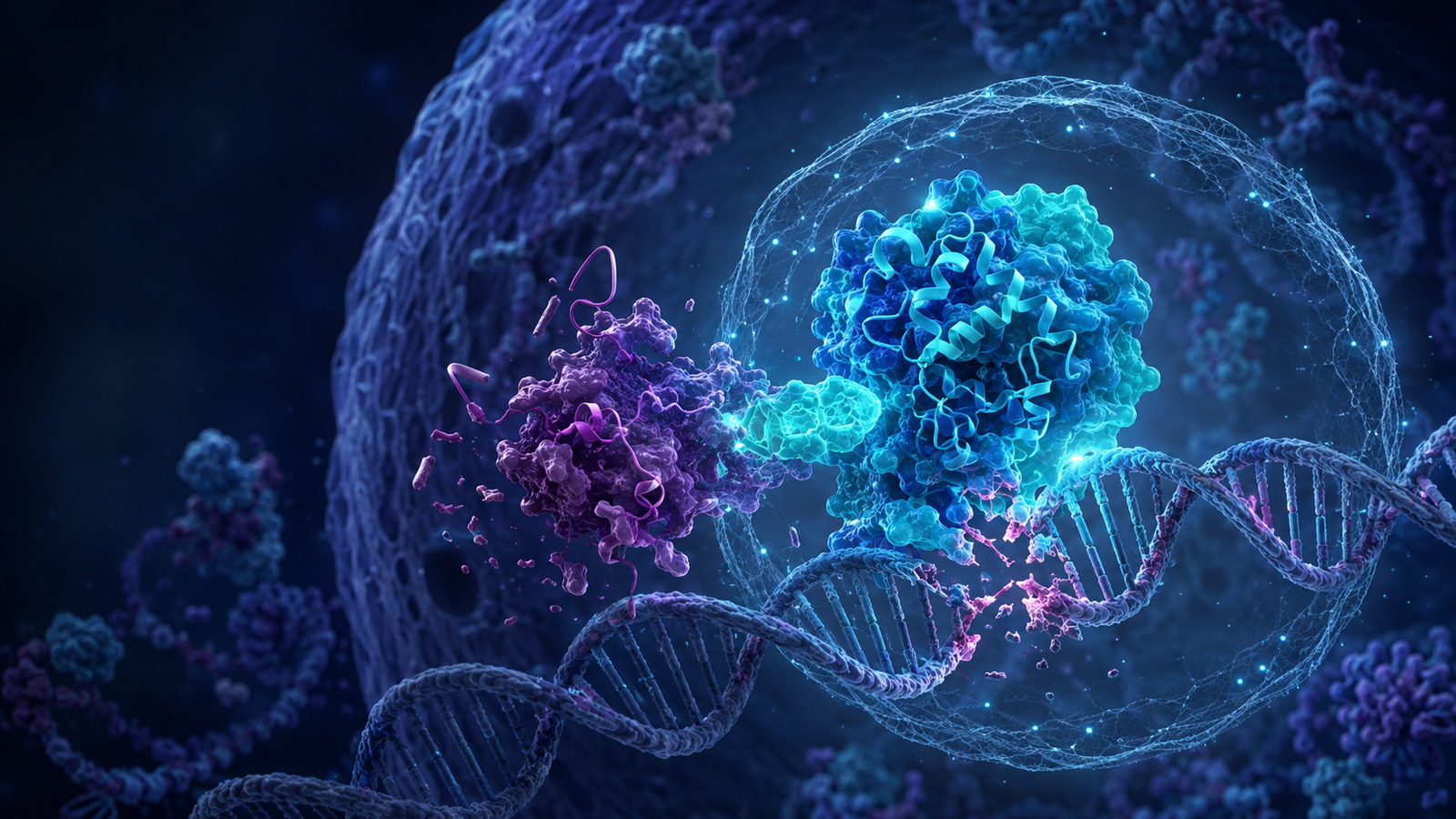
Quick answer: p53 is a protein often called the “guardian of the genome” because it helps prevent damaged cells from becoming cancerous — by pausing cell division for repair or triggering programmed cell death (apoptosis) when damage is severe. The gene that makes p53 (TP53) is mutated in a large share of human cancers, which disables this protection. Restoring, or “reactivating,” the function of mutant p53 — often called p53 reactivation — is a major and long-standing goal in cancer research.
What p53 does in a healthy cell
p53 acts as a central checkpoint. When a cell’s DNA is damaged, p53 can halt the cell cycle to allow repair, or, if the damage is too great, direct the cell to self-destruct through apoptosis. This prevents damaged cells from multiplying and forming tumors, which is why p53 is described as a tumor suppressor.
What happens when p53 is mutated
TP53 is among the most frequently mutated genes across human cancers. When p53 is mutated, the protein can lose its protective function, and in some cases gain properties that actively promote tumor growth. The result is that cells with dangerous DNA damage can survive and proliferate. Because p53 loss of function is so common, it has been a focus of oncology research for decades.
Why “reactivating” p53 is so challenging and compelling
Historically, p53 has been considered a difficult target because it is not an enzyme with an obvious pocket for a drug to block — and much of the relevant biology sits inside the cell, out of reach of conventional antibodies. Researchers have pursued several strategies for p53 reactivation, aiming to restore p53’s tumor-suppressing activity in cancer cells. The appeal is clear: if the guardian function could be switched back on selectively in tumor cells, it could, in principle, drive those cells toward apoptosis. Explore Our Science to see how this plays out in preclinical data. This remains an active field of investigation.
PHP Biotech’s research focus
PHP Biotech’s lead research candidate, PHP53-nb, is a humanized nanobody being studied for its ability to engage the p53 pathway in cancer-cell models — work aligned with the broader scientific goal of p53 reactivation. PHP53-nb is the first proof-of-concept generated from PHP Biotech’s proprietary nanobody Platform, serving as an initial validation of the broader technology rather than the company’s sole focus. The platform is a programmable, linker-free nanobody system built around a precision oncology strategy: tumor-selective delivery to biologically defined patient populations. It is intended to generate future multispecific and other next-generation biologics through a common engineering architecture, with recombinant manufacturing in CHO cells to support industrial scalability. To understand the broader clinical significance of this approach, see the Potential Impact page. PHP Biotech’s intellectual property portfolio currently includes four U.S. patent applications covering the platform, the recombinant production technology, the therapeutic peptide library, and the lead candidate PHP53-nb. All results described to date are from model systems and preclinical research.
Frequently asked questions
A protective protein that stops damaged cells from turning into cancer, by pausing them for repair or triggering their death.
The TP53 gene is mutated in a large fraction of cancers, removing a key safeguard against tumor formation.
Restoring the tumor-suppressing function that is lost when p53 is mutated — a leading goal in oncology research known as p53 reactivation. Learn more on the Our Science page.
Through PHP53-nb, a humanized nanobody and the first proof-of-concept from its nanobody Platform, studied in preclinical models for engagement with the p53 pathway.
It is an area of ongoing research; approaches are at various preclinical and clinical stages.
About PHP Biotech
PHP Biotech is a U.S.-based platform biotechnology company developing a proprietary nanobody Platform for precision oncology. Its linker-free, humanized nanobody platform integrates the therapeutic sequence directly into the nanobody through recombinant expression — an approach to recombinant nanobody therapeutics engineered to reach historically undruggable intracellular targets and to create a new class of biologics. The same programmable platform is designed to generate future multispecific and other next-generation biologics, produced in CHO cells to support industrial-scale recombinant manufacturing. PHP53-nb — a humanized nanobody in preclinical development, studied for p53 reactivation — is the first proof-of-concept generated by the platform, not the company’s only program. Read more about what this could mean for patients on the Potential Impact page. PHP Biotech’s intellectual property portfolio currently includes four U.S. patent applications covering the platform, the recombinant production technology, the therapeutic peptide library, and PHP53-nb.
Learn more at phpbiotech.com. This content is educational, describes research in model systems, and makes no efficacy, safety, or treatment claims about PHP53-nb.