

A Nanobody Platform with Diverse Applications
A Unique Nanobody Peptide Delivery Platform
Therapeutic peptides such as 3-NAntC are inherently unstable in plasma, making effective tumor delivery a major challenge. To overcome this, PHP Biotech developed GEN01-AD, a proprietary humanized camelid nanobody platform specifically engineered for peptide delivery.
Unlike conventional nanobodies designed solely for antigen binding, GEN01-AD contains patented, defined insertion sites for therapeutic peptides, enabling stable integration without the need for linkers.
This unique architecture protects the payload from degradation, while preserving its biological activity, and enabling efficient delivery into tumor cells. This creates a versatile platform for next-generation targeted biologics.
The Nanobody Platform has Significant Advantages Over Traditional Monoclonal Antibodies (mAb)
PHP53-nb is a humanized camelid nanobody. The smaller size creates many advantages.
| Comparison criteria |  Nanobody Nanobody |  mAb mAb |
|---|---|---|
| Molecular weight | ~17 kDa | ~150 kDa |
| Tumor penetration | Better | Limited |
| Stability | Higher | Lower |
| Production cost | Lower | Higher |
| Modularity | Higher ability to create conjugates and multivalents | Conjugation limitations |

PHP53-nb is Expressed in CHO Cells with Standard Bioprocessing
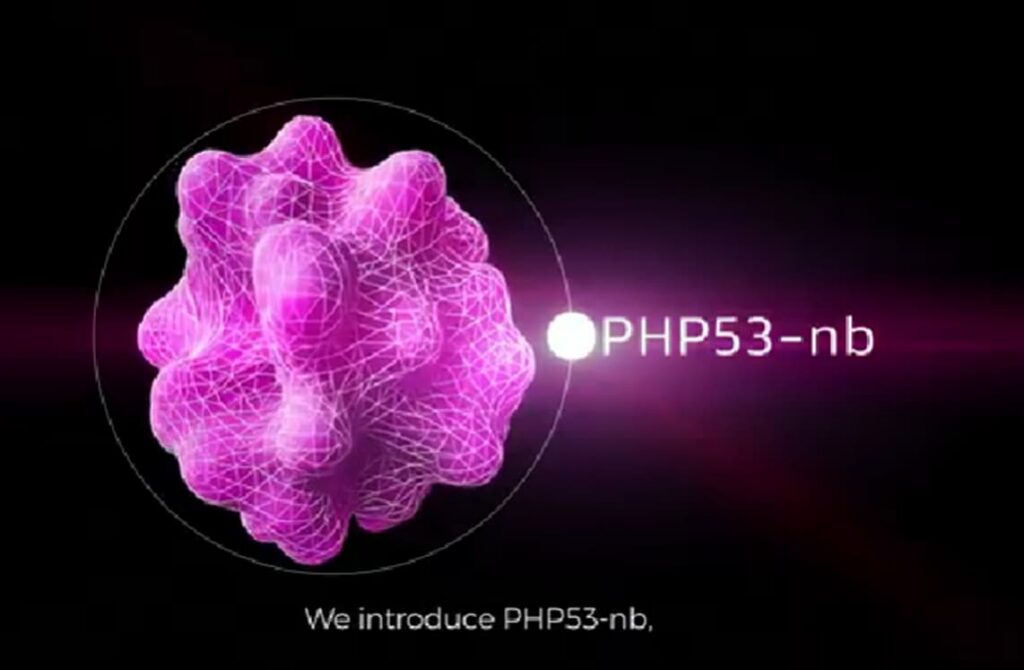
Humanized camelid nanobody
PHP53-nb is derived from camelid antibodies and humanized for compatibility with human therapeutic applications.Smaller size → deeper penetration
At 17kDa PHP53-nb is about 1/10th the size of a traditional mAb (~150 kDa), enabling deeper tumor penetration and lower immunogenicity.
No linkers required
The 3-NAntC peptide is genetically integrated into the nanobody structure itself—no chemical linkers, post-modifications, or extra manufacturing steps needed.Modular platform
GEN01-AD can be leveraged to develop other therapeutics beyond PHP53-nb supporting a broad pipeline of nanobody-based biologics.
Optimization of Production Yields of PHP53-nb
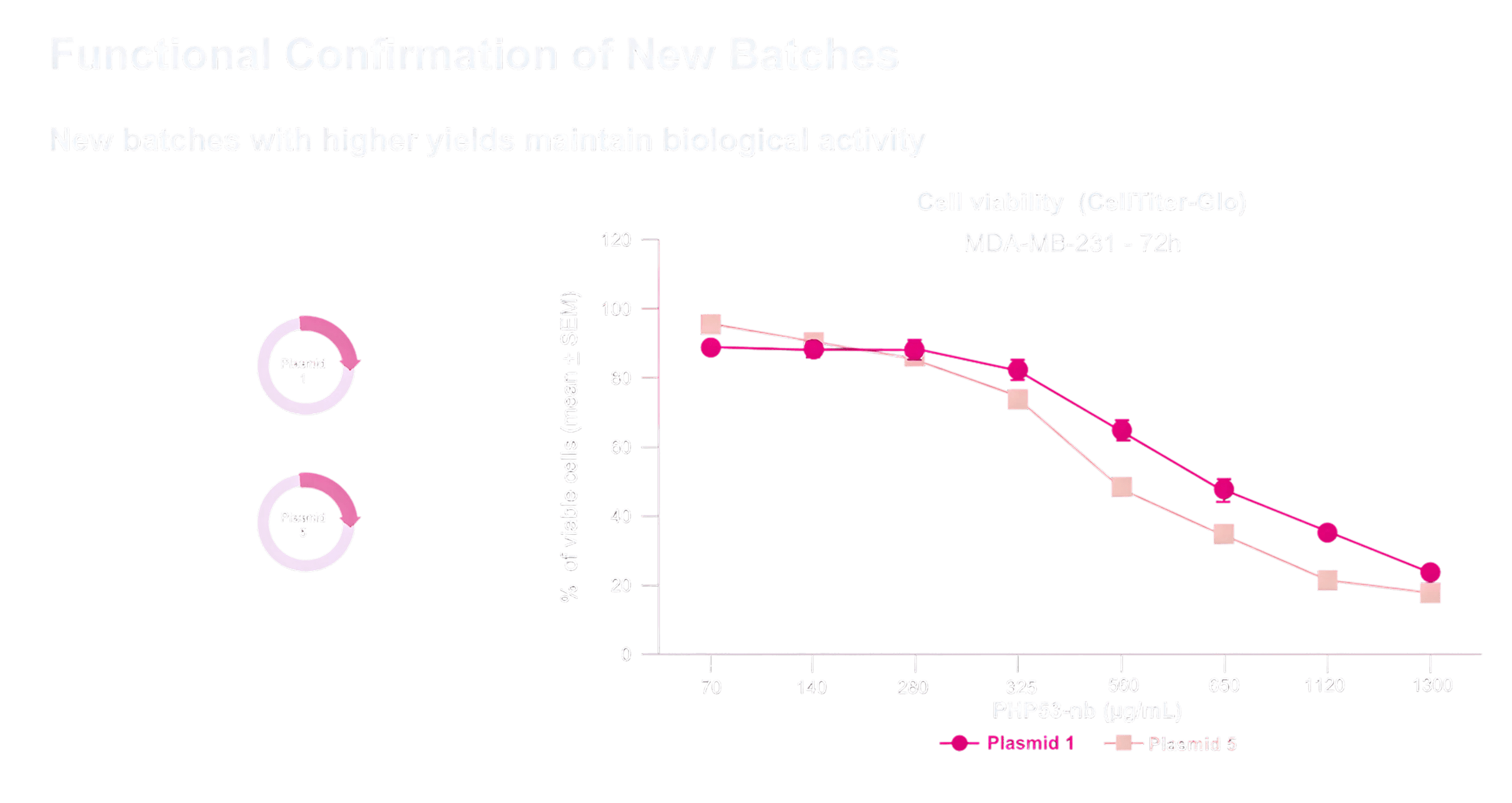
Strong yields (>1 g/L) are necessary for the commercial viability of PHP53-nb. Optimization of the plasmid has increased yields more than 100-fold compared to lab scale, 5 mg/L to 693 mg/L. Further increases in yield should occur with cell line optimization and process development.
Gene optimized plasmids demonstrate comparable activity to lab batches.

Connect With Our Team
Reach out to us to learn more about the benefits and diverse applications of our nanobody platform.
Frequently Asked Questions
What is the GEN01-AD platform?
GEN01-AD (Genetically Engineered Nanobody – Active Drug) is a platform that enables the development of active therapeutic molecules based on humanized camelid monoclonal nanobodies. Peptides can be engineered into the nanobody for effective delivery.
What are the advantages of humanized monoclonal nanobodies over traditional monoclonal antibodies (mAbs)?
Humanized nanobodies offer:
- Lower immunogenic potential
- Greater physicochemical stability
- Better penetration into tumor microenvironments due to smaller size (~1/10th)
- Efficient binding to hard-to-access epitopes
- Potential for cellular internalization
- More scalable industrial production
How is the 3-NAntC peptide expressed in the GEN01-AD platform?
The sequence corresponding to the 3-NAntC peptide is genetically inserted into the paratopic region of the plasmid expressing the nanobody. The plasmid is transfected into Chinese hamster ovary (CHO) cells, which efficiently produce human-like proteins with structural fidelity. This is a one-step method of production with no linkers, post-modifications or extra techniques that results in a complete therapeutic with no modifications needed.
How does PHP53-nb differ from Antibody–Drug Conjugates (ADCs)?
PHP53-nb is nanobody-based, making it significantly smaller than antibodies — about one-tenth the size. Additionally, PHP53-nb does not use chemical linkers to attach the active peptide to the antibody. Instead, 3-NAntC is genetically expressed within the nanobody structure itself, eliminating many complexities associated with ADC construction. Finally, PHP53-nb has been proven to selectively target only tumor cells to induce the p53-driven MOA.